Showing posts with label Bees. Show all posts

Sunday, March 17, 2013

Spring is Here

Orchids are blooming again

Last weekend when I walked into the farm, I suddenly noticed all the colorful flowers. Unlike other gardens, most of my flowers will turn into food. Many years ago, a family friend gave us a pot of orchid. We have since then separated that one pot of orchids into 3 pots. I even transplanted one pot into the ground.  For a couple years, they did not bloom. Last weekend I was surprised to see the flowers in one pot and buds in the other pot that was transplanted into the garden.  That was a big happy surprise for me!

Mizuna blossom

All the mizuna plants are almost as tall as I am, and they are in full bloom. This is what happens since I didn't eat them all. I love seeing a sea of yellow flowers with a lot of bees buzzing around them. Even though I didn't eat all the greens, the bees now can collect the pollens and make honey.  Later on the flowers will produce seeds, and next year I will have mizuna again without doing any work.

Asian pear blossom

Both the pear and peach trees are blooming. A bunch of bumble bees have joined the honey bees. Thank to their efforts, I will have a tree full of peaches again in the summer. I am really looking forward to it!

Bumble bee busy at work

Friday, May 25, 2012

Helping Honeybees Survive


I wanted to put together a short Youtube video with video clips and photographs I took during the last 3 years while working with honeybees. My goal was to bring awareness to people that honeybees are not scary and bee swarms are not Hollywood horror events. I wanted to show people that bees don't sting people unless they are provoked in most cases. I wanted to show people how beautiful the bees are and how important they are to human civilization and survival.

For the last 5 months I worked on sorting through the video clips and over 300 photographs. I did online research on history of honeybees and read a couple books on honeybees. Lastly, I spend hundreds of hours putting together the selected video clips, photographs, and sound clips in After Effects 5.5 and showed it several times to my After Effects and Beneficial Beasts in the Garden classes for feedback. The final version of the video is now on Youtube.com. I hope you like it.

Sunday, February 19, 2012

Vanishing Bees

The bees had disappeared in a week

Back on May 2, 2010, I participated in bee swarm capture for the first time. The bee colony we captured had lived on Merritt College campus for just under 2 years. Last month we opened the bee box and the entire colony had disappeared. Master Ken told us that the bees were still in the box a week ago when he checked on it. He said there could be many reasons why the bees decided to abandon their hive. There was still a lot of honey left in the hive, which we would harvest as a class and share among us. In addition to honey, we would also harvest the wax, which was regarded even more valuable than honey in the past.


The disappearance of the bees troubles me greatly. I have been reading about collapse colony disorder (CCD) since it was first discovered in 2006. I have read that it mostly affects commercial beehives and not beehives that people keep in their backyards. I hope that is still the case. In order to better educate myself in honeybees, I checked out a few books from San Francisco Public Library when I happened to be in neighborhood. One of the book is called A short History of the Honey Bee, which I think is an excellent book for someone who enjoys leisure reading. The author, "E. Readicker-Henderson is a beekeeper turned regular writer and contributor to National Geographic Traveler, Sierra, and others,..." He describes the taste of raw local honey beautifully, which brings tears to my eyes.

I also looked for documentaries on honeybee and found full episode of Silence of the Bees on PBS.org. From the documentary, I learned that in Maoxian county of Sichuan, China, people have to pollinate their fruit trees because they have lost their bees due to heavy use of pesticide. Can you imagine that? Can you imagine that you can't have an apple unless you pollinate apple blossoms one by one? That is frightening to imagine.

I now have a new goal for 2012.

Watch Silence of the Bees on PBS. See more from Nature.

Friday, June 10, 2011

Beekind


On my way to the Fermentation Festival last month, I stopped by Beekind, a store in Sebastopol that sells local and varietal honeys, bee related products, and beekeeping supplies. I have heard of this place for quite a while. What makes it stands out is that they have their own bee farm, and you can taste over 50 different honey. By the way, if you don't have car or don't want to drive all the way out to Sebastopol, they have a small kiosk inside of the Ferry Building in San Francisco that sells honey and bee wax candles.

Sebastopol is a beautiful little town. It's amazing how rapidly the scenery changes from the short drive between San Francisco to Sebastopol. The beautiful bee mural is hard to miss as you drive down Gravenstein Highway. I was very excited to be there. I entered the beekeeping supply shop briefly then quickly went to the honey shop next door. I wanted to try every kind of honey at the tasting bar. It was hard to decide what to get.


I loved California orange blossom honey cream, so I got a couple of the small jars. Since I am a big lavender fan, and there are at least 6 varieties of lavender on Sand Village Farm, I always have to try anything that's lavender flavored. Some lavender flavored edibles taste too artificial and some taste like bath products! Their Sonoma lavender honey tasted wonderful. I also got some Oregon blackberry and a bigger jar of Northwest raspberry. 

After I carried all my little glass jars of honey to the car, my friend pointed out that there were beehives in the garden behind the parking lot. We went back there to visit the bees. Since there were stacks and stacks of hives all concentrated in a small area, the bees could be intimidating to some people. A couple years ago I would not be able to approach a colony this size at ease. In July, 2010, 3 beehives in San Francisco Hayes Valley Farm were attacked by pesticide, killing up to 200,000 honeybees. I can't begin to fathom what was going through that person's mind. I don't think any healthy minded people can. As Master Ken puts it, some people are irrationally fearful of bees. When people hear me talking about bees and capturing bee swarms without protective gear, they can't imagine that I was extremely fearful of them over a year ago, but the bees have shown me that they never mean any harm to anybody as long as you don't provoke them. So, be kind to honey bees, and they will be kind to you in return.

Tuesday, April 12, 2011

Capturing A Bee Swarm


This past Sunday's class was quite exciting. First, we had a swarm of bees to capture then we got to try Miracle Berry and MBerry tablets. I will have to write about the experience with Miracle Berry in a separate blog entry.

When I got to the class on Sunday, it was windy and overcast. When I left the box of oatmeal cranberry white chocolate chip cookies on the potluck table, there was no other food item there. I wondered if we were going to have anything to eat. A few people were scattering around the hill. I heard them talking about a bee swarm. A bee swarm! Awesome! I made a connection with bees last May when I first witnessed the capturing of a bee swarm.

I immediately ran over to my car to get my camera. I had to get it on video this time.


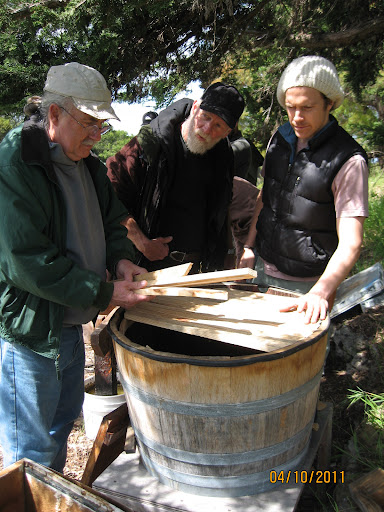
Master Ken, David, and John showed us a prototype top bar beehive that Nobuto made with a half wine barrel. Nobuto was in one of the classes last year. He has carpentry experience and the work he did with each top bar shows. They all fit perfectly on the top of the wine barrel. I remember how much difficulty I had trying to make a top cover for the fish tank that I donated to the class for snail ranching.

They set up the wine barrel beehive for the new swarm we were going to capture.

By now I am pretty calm with the bees buzzing near me. I also have a lot of trust in John, Master Ken, and David as I have seen them handling bees over several semesters. John keeps bees on his own homestead farm, so he has his own first hand experience with bees.

Unless you were as fortunate as I to personally witness bee swarm capturing with this group of people, it is hard to convince you how peaceful it felt. Of course you have to remain calm. Master Ken also mentioned that bees do not like the smell of banana, so don't eat banana before getting close to the bees. The video is about 7 minutes long, but the actual process was more like 1 hour. It was done very slowly and carefully. They are not commercial beekeepers and tried not to hurt any bee in the process.

Pruning the branches to get ready for capturing the swarm.

After David brushed all the bees into the beehive, they put the top on the wine barrel to let the bees settle in. We filled the buckets which the legs of the beehive bench sit in with more water. The water prevents the ants from crawling up the bench to get into the hives. The weeds and tree branches around the beehives were also removed to prevent them from touching the beehives and became bridges for ants. If ants got into the hives, the bees would abandon the hives.

Sunday, January 23, 2011

Growing Broccoli DeCicco


A few days ago I mentioned about gathering those broccoli DeCicco seeds, and I did it. If you let the broccoli heads bloom, each little yellow flower will turn into a seed pod. You just leave them and let the seed pods dry up completely (no longer green) on the broccoli stalks. You can then clip off a bunch of them and break them open to collect the seeds. Depending on the pod's size, you can collect anywhere from 4-8 seeds in each pod.


I think the yellow flowers are quite pretty, and the bees love them as you can see from the photos. I love bees since they are essential for honey, so I leave plenty of broccoli flowers for them. Do you see the pollen sacks on the bees' legs in the photos?


I use a Canon PowerShot SD550 to shoot photos for my blog. It's not a fancy camera, so I have to get very close to the bees in order to take closeup shots. A year ago, I would not have done that for fear of getting stung by the bees. I have definitely overcame that fear.


Many of the seed pods have cracked open when they dried up, and the seeds were dispersed. There are many seedlings growing around the original broccoli now; however, I think pill bugs or some other bugs have been nibbling on the young leaves. I will plant a few in cell packs perhaps in the greenhouse to assure they grow up nicely. They are quite hardy, and I have learned that they do best in well drained soil.

The seeds have dispersed and germinated on their own

Thursday, December 23, 2010

Bees Are Smarter Than You Think

Bombus terrestris, the buff-tailed bumble-bee. Photo taken from Biology Letters.

I came across an article, Study by 8-year-olds published in prestigious science journal, this afternoon. It caught my attention for several reasons. The title alone is impressive, but it was also a study on how bumblebees see colors and patterns. How did the 8-year-olds manage to study the bumblebees? I have a hard enough time just to get a decent photo of them. They seem to more skittish than honey bees, and I can never get close enough to get an extreme close-up of them.

Below are some excerpts from the article:

Biology Letters, a peer-reviewed journal of Britain's Royal Society, on Wednesday published a report (PDF, complete with colored-pencil diagrams) on how bumblebees see colors and patterns -- conducted and written by a group of 8- to 10-year-olds in Devon, England.

The budding scientists, working under the "light supervision" of a neuroscientist from University College, London, trained bees to go to targets of varying colors by rewarding them with sugar. They reported that the bees were capable of learning and remembering cues based on color and pattern -- a finding that the Royal Society called "a genuine advance."

The Royal Society is more than 300 years old and includes some of the world's most eminent scientists.

The report's language isn't quite what you'd expect to find in a scientific journal. "Scientists do experiments on monkeys, because they are similar to man," the introduction reads. "But bees could actually be close to man too."


These kids have trained the bees to learn and remember colors and rewarded them with sugar!!!! How awesome is that!!!!??????  I was just about to flip over in my chair as I read this. I spent some time learning about bees and beekeeping in Master Ken's Beneficial Beasts in the Garden class. I was surprised at how peaceful the honey bees are. They really are not as scary as people think once you know how they behave. The sad part is, most people refuse to spend 5 minutes of their time to learn how honey bees "think." When I try to explain to people that bee swarms are not there to attack people. They usually try to cut me off by telling me how dangerous they are especially when there are children around. Well, I have seen the students on Merritt College campus scooping up the bee swarm with no special protective gear and nobody got stung. These 8-year-old children have successfully trained their bees for their science experiment, and it's now published in The Royal Society. Perhaps, some adults are not giving children enough credit and forcing their own fear onto their children.

The children concluded: "We like bees. Science is cool and fun because you get to do stuff that no one has ever done before."

Indeed! This was the most awesome news I have seen in a while.

Thursday, December 16, 2010

A Glimpse Into An Urban Bee Colony


While slaving in the cubicle world, my friend Rosa popped in and told me to take a break and walk around the neighborhood. I jumped up and ran out of the door with her. Seeing the sky is a treat when you work in the cubicle world. We walked across the street and passed by one of our favorite houses in the area. Its front yard has an assortment of interesting drought tolerant plants of various sizes. They are all strategically placed and visually stimulating. There is a sign between the plants with contact information of Vee Horticulture.


One of the agave plants is about to flower. It's not common to see an agave in someone's front yard with a stem in the middle that's taller than the house. According to Wikipedia, agave only flowers once. After it's flowered and developed of fruit, the original plant dies. I will go back to the garden to see the flowers and fruit of the agave.

Next to the agave house there is a wooden fence. Rosa eagerly told me to look into the holes on the fence. Bee boxes!!!! I could see the bees busy coming in and out through the openings of the boxes.


As a breeze blew my direction, I could smell the sweet scent of pure raw honey. Wow, that is a honey heaven behind this fence. I took several deep breaths to inhale that sweet smell of pure honey. We stood there peeking into the fence with envy. Rosa started telling me that she learned about beekeeping in school when she lived in Mexico. I have learned some basics from Master Ken's Beneficial Beasts in the Garden course, but I have yet handled bees. I am excited to know that there are more and more urban beekeepers in the area. There is also a beekeepers association in San Francisco that I would like to become involved to learn more about beekeeping.

Sunday, July 18, 2010

Revisting the Newest Bee Colony


Remember those 700 bees that we captured last semester? We opened their box to check on them today for the first time since we placed them in the bee box along with the cardboard box on May 2, 2010.

The top picture is what we saw inside of the box when David finally pried open the lid. The box was filled with honey. Under the bee box lid was attached with the top portion of the beehive and saturated with honey (see picture below).


I am getting really bold around the bees. I know that I am supposed to be calm and move gently around the bee hives, but I was so excited to see how much progress these bees have made. They really made a new home for themselves. I was moving back and forth taking pictures and trying to get better angles. As you can see from the pictures, most of us just had our regular clothes on. Some of us were wearing short sleeve shirts and shorts. It was a very hot day.

If you are afraid of bees like I was, I can tell you that bees are peaceful creatures. See how we broke their hive and robbed their honey? Nobody got stung today just like May 2 when we brought them to their new home.

See Revisiting the Newest Bee Colony for more pictures.

Wednesday, June 16, 2010

The Secret Life of Bees


I was about to clip some lavender and spotted a few honey bees in the lavender bush. Watching them flying around lavender blossom took me back to that day when I made my connection with them. Like most girls, I was not particular fond of insects especially ones that sting. Most insects are not cute to me. The buzzing sound of bees were scary until very recently.

The campus where I take my horticulture classes has a few bee boxes. We check on the bees regularly as a class activity. I normally stayed further away than most people. I have never been stung by a bee, but base on what I know about myself, I am nearly 100% sure that I am allergic to bee stings. My skin swells up at the slightest irritation. I am often covered with red rashes just from being around weeds. The rashes usually go away on their own, so I stopped thinking much about it.


On May 2, 2010, I was hanging out on the campus farm when someone spotted a swarm of bees. The few people from my class who stayed late were very excited at the opportunity of capturing the swarm. Now you wonder how you are going to "capture" a swarm of 400-700 bees? My mentor, Master Ken, will tell you to be very slow, gentle, and calm, and you will then be able to sweep the swarm of bees into a paper bag with your bare hand. He has described this process to us in the class, but it had not been witnessed by us.

They found the actual swarm resting on top of a tree while the loose bees were flying around in search of a new home. The guys went and got 2 ladders in order to reach the bees on the tree. They also got a cardboard tube to put the bees in. They had to carry all these things and climb over a tall wire fence to get to the tree with the bees.


It took them about an hour to come back to the campus side of the fence with a tube of bees. I was too wimpy to get over the fence to where the swarm was. I didn't even want to hold the tube of bees in my hands. However, as I watched the others (yes, there were girls, too!) handling the bees without any protective clothing, I grew more confident. The bees meant us no harm. They were peacefully doing their own thing.


For the first time I got close to the bee boxes so I could take a closer look at them. They were these fuzzy creatures with big eyes. When they returned to the boxes from working, they carried pollen sacks on their hind legs! How cute! I tasted the sweetness of fresh pure honey from the hive, too. Nobody got stung that day.

That day I made a connection with honey bees. I know I am not quite ready to keep my own boxes on Sand Village Farm, but I no longer flinch from the buzzing sound of their wings. If they need to take a break on my shoulder, I am okay with that.

See The Secret Life of Bees photo album for more pictures from May 2, 2010.