Showing posts with label Master Ken. Show all posts

Friday, May 25, 2012

Helping Honeybees Survive


I wanted to put together a short Youtube video with video clips and photographs I took during the last 3 years while working with honeybees. My goal was to bring awareness to people that honeybees are not scary and bee swarms are not Hollywood horror events. I wanted to show people that bees don't sting people unless they are provoked in most cases. I wanted to show people how beautiful the bees are and how important they are to human civilization and survival.

For the last 5 months I worked on sorting through the video clips and over 300 photographs. I did online research on history of honeybees and read a couple books on honeybees. Lastly, I spend hundreds of hours putting together the selected video clips, photographs, and sound clips in After Effects 5.5 and showed it several times to my After Effects and Beneficial Beasts in the Garden classes for feedback. The final version of the video is now on Youtube.com. I hope you like it.

Monday, February 6, 2012

Beneficial Beast in the Green House


After taking a long break from Master Ken's Sunday gardening classes, I am now back in the green house on Merritt College campus. This past Sunday we cleared out all the dead plants, propagated rooted plants, and made new cuttings. While we were busy clipping, potting, and misting, Master Ken came through one of the doors announcing that he just found a "beneficial beast"! Everyone gathered to see what he was talking about. He extended his arms and opened up his hands. There was a brown Pacific Tree Frog in his palm. He told us that this frog is definitely beneficial to us because it eats bugs in the green house. After he showed us the frog, he put it back in the back green house where it was discovered.

Saturday, May 28, 2011

Freestone Fermentation Festival


A week ago I attended Freestone Fermentation Festival. At the festival, I sampled different kinds of kimchi, cheeses, miso, pickles, sauerkraut, natto and kombucha. Kombucha was extremely popular at this year's festival because of its first People’s Kombucha Awards.

I put my hand in a cedar enzyme bath. It was the first time I heard such a spa treatment. It felt nice because it's warm, and I am sure it's relaxing to be buried in it. It's probably similar to being buried in hot sand on a beach, but I am not sure about other health benefits it offers.

Mycological Society of San Francisco had a booth at the event to promote the organization. Master Ken and many of his students from Merritt College were there tending the booth. Master Ken was also a speaker at the event. His "FermentoMondoRama: Get Down and Dirty with Fermentation" was a demonstration that involved heavy audience participation. Within minutes after he introduced himself and his assists, people have volunteered to go up to the front to make bread, sauerkraut, and mead with prickly pears. I just recently got a Toshiba Camileo H30 camcorder, so I was busy recording the event. Below is a short clip of Mater Ken explaining how to capture local yeast:

Thursday, May 19, 2011

Harvesting Spinach


I saved some pathetic looking spinach seedlings from the greenhouse on Merritt College campus in January this year. There were 18 seedlings packed into a 6-cell pack. They were going to the compost pile, but I decided to take the time to separate them into 3 6-cell packs. They sat on my outdoor propagation table for about 3 months before I transplanted them in one of my vegetable beds at the end of March. They would have grown faster if I kept them inside but then I might forget to water them. I left them on the propagation table so they could get misted everyday.


For a while I thought I was losing all of them to the pill bugs. I asked Master Ken what I could do to get rid of the pill bugs safely. I don't ever want to use pesticide on anything I grow. He told me to spray my soil where the bugs are with diluted soapy water. We are talking about 2 drops of dish detergent in 1 quart of water. This is similar to another friend's recipe on getting rid of aphids.

I sprayed the spinach bed with the solution, and within days I saw a significant improvement. In one particular corner, the spinach started to flourish. Every year I try to grow spinach because it is my favorite green leafy vegetable. They aren't as big as super market bunches, but I get to pick them right in my own yard, and I know they can never be contaminated with e-coli. I am going to sauté this whole basket of spinach with a little olive oil and garlic and grill a piece of hamachi fillet for dinner .

Monday, April 18, 2011

Green Faerie Farm Field Trip


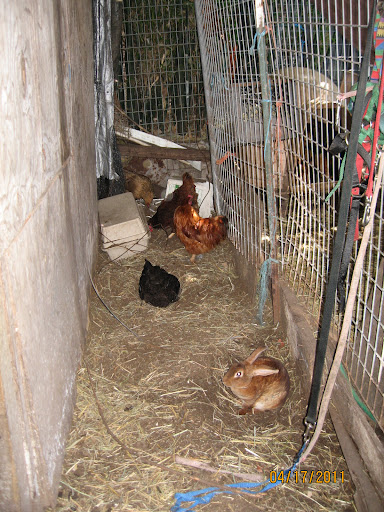
Green Faerie Farm is a homestead farm in Berkeley. They raise dairy goats, rabbits, chickens, keep bees, and grow many kinds of vegetables and fruits. This past Sunday, Master Ken arranged to have our Beneficial Beasts in the Garden class to meet at Green Faerie Farm.  Co-owner, Jim, gave us a tour and a list of tasks that he would like our help, including grinding flax seeds, vaccinate the goats, pull out the nasty hay out of the goat barn and add it to the compost pile, chop some bamboos, and treat the rabbits for ear mites.


The goats and kids were quite friendly. They liked to be petted just like other pets we are familiar with. Some rabbits were kept in the same enclosure with the goats and chickens. It was fun to see all the animals living in harmony.

Besides the animals and vegetables, the farm has a wide variety of fruit trees - avocado, plum, grapefruit, walnut, kiwi, pear, orange, thorn-less blackberry, mulberry, etc. Jim has also attended Scion Exchange for some of his fruit tree collection.


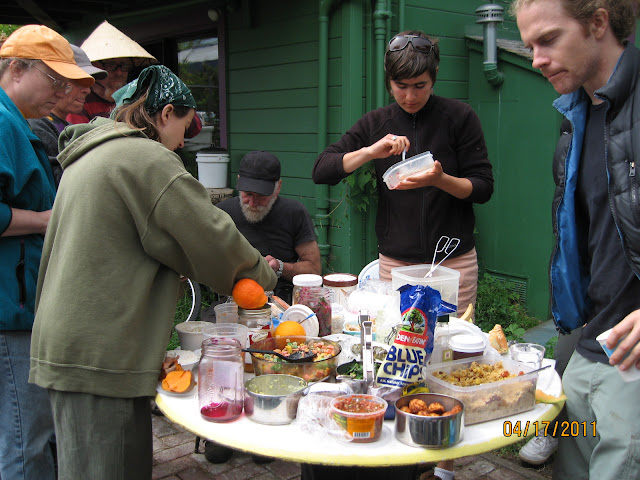
Our potluck was quite a feast, including homemade candy cap cream cheese, coconut macaroons, baked yam, hummus, couscous, homemade ranch dressing, cultured butter, several kinds of homemade pickles, and Tara's organic ice cream. Lisa also brought a variety of her award winning kombucha drinks. Her latest flavor is rose kombucha.

It was a fun filled day with a very festive and satisfying potluck at Green Faerie Farm. I made a short video clip to show you what the farm looks like:

Thursday, April 14, 2011

Miracle Berry Test


Towards the end of our Sunday potluck, I saw Jason brought over two Tupperware full of lemon and lime wedges, a bag of salt and vinegar chips, and a brown paper bag. I thought that was odd that he brought in his potluck item when we were almost done eating, but what were the lemon and lime wedges about?  Surely we weren't just going to eat them.

My confusion didn't last long as Master Ken started to explain what Miracle Berries (Synsepalum dulcificum) were and how long the artificial sweetener industry has been trying to keep them out of U.S. market. "Synsepalum dulcificum produces berries that, when eaten, cause sour foods (such as lemons and limes) subsequently consumed to taste sweet. This effect is due to miraculin, which is used commercially as a sugar substitute. Common names for this species and its berry include miracle fruit and miracle berry. The berry itself has a low sugar content and a mildly sweet tang. It contains a glycoprotein molecule, with some trailing carbohydrate chains, called miraculin. When the fleshy part of the fruit is eaten, this molecule binds to the tongue's taste buds, causing sour foods to taste sweet. While the exact cause for this change is unknown, one theory is that miraculin works by distorting the shape of sweetness receptors "so that they become responsive to acids, instead of sugar and other sweet things". This effect lasts 15–60 minutes." (excerpt from Wikipedia)

Jason brought in 5 berries and a pack of mberry tablets, which are made from miracle berries. He also brought in lemon and lime wedges, a bag of salt and vinegar chips, and a bottle of apple cider vinegar for us to have a taste test. I became more and more excited as Master Ken explained what these berries do. The fresh berries were ordered online, and they were $5 each! The tablets were picked up from a store in New York when Jason was there recently. Many of us donated a few dollars to Jason since he  spent quite a bit of money to get these items.

The berries were cut up in small pieces and the seeds were saved so we can try to grow them in the green house. Some of us took the fresh berry pieces and some took the tablets. I took a tablet. For a few minutes, we sucked on the tablet and swirled it inside of our mouths so it could start to take effect. As soon as the tablet completely dissolved, I started with a piece of lemon wedge.

"It tasted like a piece of sweet orange. It didn't taste sour at all!" I announced to the group. Now everyone started to take lemon wedges or lime wedges. I then tried a piece of lime. It was sweet as well. That was so amazing. I took a small piece of strawberry, and it was super sweet. The cherry tomato was sweet. The apple cider vinegar tasted really good. Wow, I couldn't believe it! The lemon and lime wedges were disappearing fast.

We were all trying different things on the table and laughing. It was just amazing. All of us are pretty healthy, and we certainly don't have much need to enhance our taste in sweetness. We talked about how cancer patients and people with health issues can benefit from the berries. I personally never consume artificial sweeteners. I have grown stevia and I love pure honey. I use real sugar when I bake sweets. For people who can't have real sugar, Miracle Berry would be a much better alternative than any artificial sugar substitute.

Tuesday, April 12, 2011

Capturing A Bee Swarm


This past Sunday's class was quite exciting. First, we had a swarm of bees to capture then we got to try Miracle Berry and MBerry tablets. I will have to write about the experience with Miracle Berry in a separate blog entry.

When I got to the class on Sunday, it was windy and overcast. When I left the box of oatmeal cranberry white chocolate chip cookies on the potluck table, there was no other food item there. I wondered if we were going to have anything to eat. A few people were scattering around the hill. I heard them talking about a bee swarm. A bee swarm! Awesome! I made a connection with bees last May when I first witnessed the capturing of a bee swarm.

I immediately ran over to my car to get my camera. I had to get it on video this time.


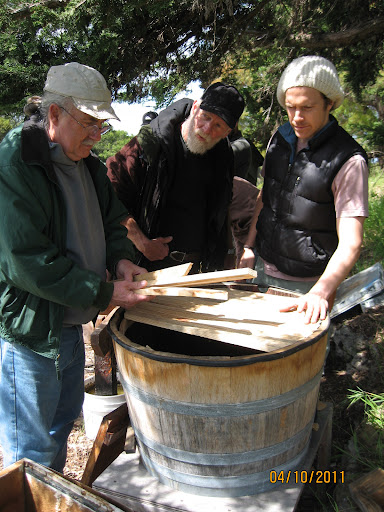
Master Ken, David, and John showed us a prototype top bar beehive that Nobuto made with a half wine barrel. Nobuto was in one of the classes last year. He has carpentry experience and the work he did with each top bar shows. They all fit perfectly on the top of the wine barrel. I remember how much difficulty I had trying to make a top cover for the fish tank that I donated to the class for snail ranching.

They set up the wine barrel beehive for the new swarm we were going to capture.

By now I am pretty calm with the bees buzzing near me. I also have a lot of trust in John, Master Ken, and David as I have seen them handling bees over several semesters. John keeps bees on his own homestead farm, so he has his own first hand experience with bees.

Unless you were as fortunate as I to personally witness bee swarm capturing with this group of people, it is hard to convince you how peaceful it felt. Of course you have to remain calm. Master Ken also mentioned that bees do not like the smell of banana, so don't eat banana before getting close to the bees. The video is about 7 minutes long, but the actual process was more like 1 hour. It was done very slowly and carefully. They are not commercial beekeepers and tried not to hurt any bee in the process.

Pruning the branches to get ready for capturing the swarm.

After David brushed all the bees into the beehive, they put the top on the wine barrel to let the bees settle in. We filled the buckets which the legs of the beehive bench sit in with more water. The water prevents the ants from crawling up the bench to get into the hives. The weeds and tree branches around the beehives were also removed to prevent them from touching the beehives and became bridges for ants. If ants got into the hives, the bees would abandon the hives.

Wednesday, April 6, 2011

Weeding

Before

A couple Sundays ago, Master Ken spent at least an hour talking about mulching and weed control. He said that he personally doesn't spend much effort fighting weeds, but if we really want to suppress weeds, we need to get 3-4 inches of mulch. When Backyard Food Garden worked on Sand Village Farm last year, they dumped 2 truck loads of mulch on the farm. It barely covered the area. Now after the rain season, much of the weeds have returned. I also noticed some new weeds that I don't remember seeing before.

During Master Ken's lecture, Crabgrass and Bermuda Grass were mentioned as two common tough weeds to control. I didn't know exactly what they looked like at the time, but I was pretty sure I have both on the farm among many others, such as California poppy and Nasturtium. Anything can be a weed if it is growing in the areas that you don't want them to be.

After

The patio area was now covered with weeds. You could barely see the patio. It was time to pull those weeds out, so I can host BBQ gatherings during the summer months. I spent just under an hour pulling as many weeds as possible from between the bricks. It gets hot very quickly when you are doing bending, squatting, and pulling under the sun. I got about half way done and decided to finish up later on, possible after the sun goes down.

I saved a few California poppy and nasturtium plants that I pulled out. A friend of mine loves anything orange including orange flowers. California poppy and nasturtium both have bright orange flowers, so I am going to see if I can get them to grow in a couple pots. From past experience I know they don't transplant well. Alternatively I can grow them from seeds.

California poppy is considered a weed on the farm

Monday, April 4, 2011

Still Trying to Grow Some Cherries

one of the grafted cherry scions is blooming

I grafted some apple, plume, and cherry scions after coming back from the scion exchange in January. It was my first time grafting fruit trees. I found out later on that the ideal grafting weather is a heavily overcast day. A sunny day would great reduce the success of grafting because the scions have a much higher chance of drying out before establish themselves on the trees. Additionally, I didn't have enough grafting tape. After stopping at 2 stores and not able to find any grafting tape, I simply used some masking tape that was readily available in my garage.

I didn't expect much success in my first attempt to graft. To my surprise, one of the cherry scions is now blooming! In the picture above, I grafted 2 scions to one branch. One of them is budding and blooming. This is the only scion that shows obvious signs of life among all the scions I grafted. I might have additional success on the apple tree, which I will find out in a month.

planted cherry scion

In addition to grafting, I also planted one cherry scion in a small pot. It appears to be still alive although I am not sure how much it has rooted. It got knocked over a few times either by squirrels or birds. I also planted a small Capulin cherry tree in December. This is a fast growing variety which can reach 10 feet in 12-18 months and eventually reach up to 30 feet. I will have to make sure to cut it back so it doesn't reach 30 feet! I can't possibly pick the cherries from a 30 feet tree.

Master Ken actually told us in the class that we will most likely not getting any cherries from our yards if we don't have any barrier to keep birds and squirrels away.

planted Capulin cherry

Saturday, November 13, 2010

Mendocino Mushroom Camp Weekend - Day 2

Coral mushrooms can be seen all over the forest

Day 2 is filled with both long and short forays plus various classes - Mushroom Identification, Polypore Paper Making, Cultivation Seminar, Cooking Demo, etc. There is no way anyone can attend everything. Although I wanted to go wherever Master is going, I end up going on a long foray with Norm's group. I am focusing on finding some porcini.

We stop at 4 different spots. At the second spot, I find 2 golden chanterelle, one candy cap, and a baby porcini among many other non-edibles. I find it odd that I am finding such a small amount of each. Normally when you spot one of these mushrooms, you are likely to find a bunch of them nearby.

Norm, Sebastian, and Master Ken (left to right) cooking up some hay for Sunday's cultivation seminar

Dinner is pork loin with creamy chanterelle sauce, Brussels sprouts with bacon, and candy cap mashed sweet potatoes. I am not a fan of Brussels sprouts. In fact, I even made fun of them when I saw them being prepped last night. Now I am helping myself with second serving of Brussels sprouts. Dessert is mixed fruit granola cobbler with fresh whipped cream on top. Needless to say, everything is excellent. After dinner, we all head over to the other meeting hall for David Arora's presentation.

MycoMendoMondo takes place at midnight

Around midnight a group of us gather back in the kitchen for Master Ken's MycoMendoMondo. Master Ken explains that we are going to cook up various unusual wild mushrooms for taste test, make a candy cap cheesecake, brew some apple mead, etc. This is for the hardcore adventurous people as it goes on until almost 4 A.M. Half of the people give up shortly after. Some people return after a nap. Scaly chanterelle, puffballs, gomphus clavatus (pig's ears), and amanita muscaria are cooked separately for everyone to try.

Master Ken holds a kombucha mother while he explains how to make kombucha tea

I cook up a quart of "oriental tea" and add a cup of sugar to it. After it is cooled down, Master Ken talks about Kombucha tea making and adds the sweet tea to the Kombucha jar to feed the mother.

All the mushrooms taste excellent especially since we have Chef Pauly cooking them. My favorite is the puffballs. I will need to start hunting for them. After we all have a taste of candy cap cheesecake, we begin to clean the kitchen for tomorrow's breakfast crew. What a day!

Taste testing

Friday, November 12, 2010

Mendocino Mushroom Camp Weekend - Day 1

My cabin in the woods

The biggest annual event of MSSF (Mycological Society of San Francisco) is the 3-day Mendocino Camp in November. I am attending the camp for the first time since I joined MSSF five years ago. It's a 4-hour drive from El Cerrito to Mendocino. Since I have never attended an event like this before, I packed everything according to the "list of the things to bring" that Lou, MSSF President, emailed to all attendees.

As I enter Mendocino Woodlands Camp, it is as if I am entering a parallel universe. I am surrounded by tall trees, green moss and other vegetation. I can see mushrooms on both sides of the road as I drive further into the woods.


I arrive the camp around 2:30 PM. There are only a few early birds at the parking area. I check in shortly after and head over to my cabin, #35. The cabin in the woods looks like something out of a fairy tale. The cabin has a fire place, 4 beds, and a balcony. There is a shared bathroom with showers about 30 feet away. After I unload my stuff, I hike back to the dinning hall for the Early Bird Foray lead by Norm.

The kitchen inside of Dinning Hall

About 20 of us head over to Camp 2 with Norm in a 15-passenger van. Some people come as far as Salt Lake City and some come with their little kids. The attendees range from age 6 to 70 something (my guess). We all become fast friends as we roam in the woods. It gets dark around 4:30, so we have our mushroom ID session in the dark with flashlights. Each of us carries a flashlight as soon as the sun goes down. The forest is pitch black at night, and there is no lighting in our cabins.

Norm (wearing brown hat) IDs wild mushrooms for us

For dinner, we have wild mushroom lasagna loaded with porcini and chanterelle. After dinner, I see that Master Ken has gathered a full basket of beautiful golden chanterelle already! He is setting up his dehydrator to dry his chanterelle. I am going to follow Master Ken anywhere he goes tomorrow!

Master Ken and his basket of golden chanterelle

Monday, July 12, 2010

Cooking with Herbs


Monday nights are school nights for me this summer. I am learning about useful herbs from Master Ken. Tonight Master Ken wanted to do a live demo of decoction, also known as making soup, during the class. He brought in some celery, sweet corn, carrots, herbs and a few loquats from Alemany Farm, where he volunteers on Monday afternoons.

Before we started cooking, we got to take a walk through the campus garden to pick more veggies and herbs. I immediately grabbed my basket and ran out there. I love the campus garden! We will never go hungry there. We picked big fat zucchinis, green beans, new potatoes, a couple heads of broccoli, basil, rosemary, rose pedals, garlic, onion, strawberries, etc. My basket was getting really heavy. I left my camera on my desk otherwise I would have taken pictures.


While the soup was cooking, Master Ken started making a special blend of pesto. In addition to basil and olive oil, he also added some blueberry juice and loquats. The pesto was naturally neon green and sweet. It wasn't bad at all. Later on he added some salt and perhaps a few other herbs to it. I had some tortilla chips with the sweet pesto.

The soup turned out quite well, too. How could it not? Everything was so fresh. The soup tasted great and healthy. Food tastes so much better when you get to pick it from your garden where you have put in the time and sweat.