Tuesday, April 26, 2011

Planting Red White Daikon


When my parents visited Tokyo last autumn, they came upon Tokyo University of Agriculture students handing out vegetable seeds to promote "grow it yourself" and their university. One of the packs they brought back is "Red White Daikon." I don't know whether there's an American name for this variety. The closest photos I can find on the web are the ones called "Long Red Radish" or "Long Red Scarlet." These are summer radishes.

I planted the seeds about a month ago, and they germinated nicely. I can see the little red roots. I cleared out a spot in one of the vegetable beds, turned the soil, and mixed in some compost during the weekend for transplanting the red white daikon seedlings.


To avoid pill bugs from devouring the seedlings, I sprayed the soil with some very diluted soapy water. It's a couple drops of dish detergent mixed into a quart of water. It's similar to the recipe I got from my friend for getting rid of aphids. I think adding cooking oil is optional. This is a safe way to get rid of garden bugs without using harmful chemicals.

I planted 12 of them, and I still have 6 more. I am keeping a few for now as backups in case some of them don't survive in the vegetable bed. 

Saturday, April 23, 2011

Bunny Lawn Mower

"I can't eat all these!" says Dusty

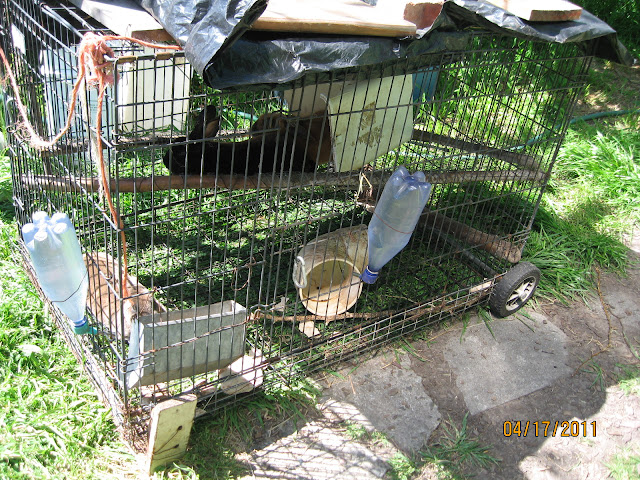
I first saw Green Faerie Farm's Bunny Lawn Mower a year or two ago, and thought that was a great idea. It's a wheeled cage with rabbits inside, so that the rabbits eat the weeds and fertilize the soil with their poop. I thought that I should have Dusty doing the same thing.

I was once again reminded that I should put Dusty to work after my most recent visit to Green Faerie Farm. Today, I carried his cage from under the patio to a patch with lots of Bermuda Buttercup, another weed that keeps spreading on its own. I have seen Dusty eating this particular weed in the past, so I placed the cage there and removed the bottom trays.

I placed Dusty inside. He was busy sniffing everything for a while before settling down and munching on some weeds. I put a piece of plastic tarp on top of the cage and one of bottom trays on top of it to keep it from blown away. This way Dusty could stay in the shade while he was outside. I shall make a hammock for him like the one they have for Green Faerie Farm's rabbits. I don't expect Dusty to be as efficient as Green Faerie's rabbits since they work as a team of 4 or 5.

Green Faerie Farm's Bunny Lawn Mower has 4 or 5 rabbits inside

Monday, April 18, 2011

Green Faerie Farm Field Trip


Green Faerie Farm is a homestead farm in Berkeley. They raise dairy goats, rabbits, chickens, keep bees, and grow many kinds of vegetables and fruits. This past Sunday, Master Ken arranged to have our Beneficial Beasts in the Garden class to meet at Green Faerie Farm.  Co-owner, Jim, gave us a tour and a list of tasks that he would like our help, including grinding flax seeds, vaccinate the goats, pull out the nasty hay out of the goat barn and add it to the compost pile, chop some bamboos, and treat the rabbits for ear mites.


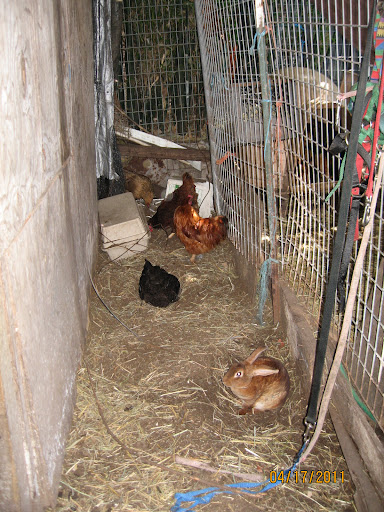
The goats and kids were quite friendly. They liked to be petted just like other pets we are familiar with. Some rabbits were kept in the same enclosure with the goats and chickens. It was fun to see all the animals living in harmony.

Besides the animals and vegetables, the farm has a wide variety of fruit trees - avocado, plum, grapefruit, walnut, kiwi, pear, orange, thorn-less blackberry, mulberry, etc. Jim has also attended Scion Exchange for some of his fruit tree collection.


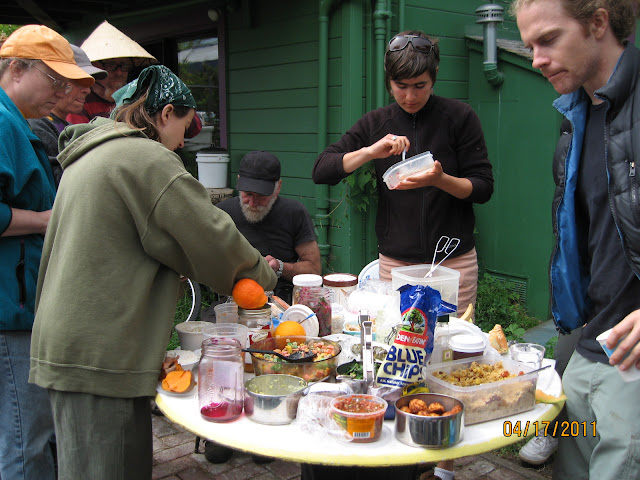
Our potluck was quite a feast, including homemade candy cap cream cheese, coconut macaroons, baked yam, hummus, couscous, homemade ranch dressing, cultured butter, several kinds of homemade pickles, and Tara's organic ice cream. Lisa also brought a variety of her award winning kombucha drinks. Her latest flavor is rose kombucha.

It was a fun filled day with a very festive and satisfying potluck at Green Faerie Farm. I made a short video clip to show you what the farm looks like:

Sunday, April 17, 2011

Mushrooms Just Keep Popping Out


As the weather gets warmer, I have been out on the farm picking snow peas and checking on the fruit trees on a regular basis. Last weekend I was surprised to see a bunch of oyster and Shiitake mushrooms growing on the mushroom blocks I got from Far West Fungi back in October last year. They were big and some of them were a little past their prime. I couldn't believe that I didn't see them earlier even though I have been working out on the farm almost everyday. It was as if they popped out overnight.


I now keep the blocks under the propagation table, which gets misted everyday for all the vegetable seeding on the table. The water drips down the table onto the mushroom blocks to keep them from completely drying out. I picked all the mushrooms to make a plate of sauteed mushrooms. I also added some thinly chopped green onions just before I turned off the stove.


Today I thought I would check on the blocks again, and there are more Shittake mushrooms popping out. I am going to let them grow a little bigger before having them for dinner.

Thursday, April 14, 2011

Miracle Berry Test


Towards the end of our Sunday potluck, I saw Jason brought over two Tupperware full of lemon and lime wedges, a bag of salt and vinegar chips, and a brown paper bag. I thought that was odd that he brought in his potluck item when we were almost done eating, but what were the lemon and lime wedges about?  Surely we weren't just going to eat them.

My confusion didn't last long as Master Ken started to explain what Miracle Berries (Synsepalum dulcificum) were and how long the artificial sweetener industry has been trying to keep them out of U.S. market. "Synsepalum dulcificum produces berries that, when eaten, cause sour foods (such as lemons and limes) subsequently consumed to taste sweet. This effect is due to miraculin, which is used commercially as a sugar substitute. Common names for this species and its berry include miracle fruit and miracle berry. The berry itself has a low sugar content and a mildly sweet tang. It contains a glycoprotein molecule, with some trailing carbohydrate chains, called miraculin. When the fleshy part of the fruit is eaten, this molecule binds to the tongue's taste buds, causing sour foods to taste sweet. While the exact cause for this change is unknown, one theory is that miraculin works by distorting the shape of sweetness receptors "so that they become responsive to acids, instead of sugar and other sweet things". This effect lasts 15–60 minutes." (excerpt from Wikipedia)

Jason brought in 5 berries and a pack of mberry tablets, which are made from miracle berries. He also brought in lemon and lime wedges, a bag of salt and vinegar chips, and a bottle of apple cider vinegar for us to have a taste test. I became more and more excited as Master Ken explained what these berries do. The fresh berries were ordered online, and they were $5 each! The tablets were picked up from a store in New York when Jason was there recently. Many of us donated a few dollars to Jason since he  spent quite a bit of money to get these items.

The berries were cut up in small pieces and the seeds were saved so we can try to grow them in the green house. Some of us took the fresh berry pieces and some took the tablets. I took a tablet. For a few minutes, we sucked on the tablet and swirled it inside of our mouths so it could start to take effect. As soon as the tablet completely dissolved, I started with a piece of lemon wedge.

"It tasted like a piece of sweet orange. It didn't taste sour at all!" I announced to the group. Now everyone started to take lemon wedges or lime wedges. I then tried a piece of lime. It was sweet as well. That was so amazing. I took a small piece of strawberry, and it was super sweet. The cherry tomato was sweet. The apple cider vinegar tasted really good. Wow, I couldn't believe it! The lemon and lime wedges were disappearing fast.

We were all trying different things on the table and laughing. It was just amazing. All of us are pretty healthy, and we certainly don't have much need to enhance our taste in sweetness. We talked about how cancer patients and people with health issues can benefit from the berries. I personally never consume artificial sweeteners. I have grown stevia and I love pure honey. I use real sugar when I bake sweets. For people who can't have real sugar, Miracle Berry would be a much better alternative than any artificial sugar substitute.